Understanding the Essentials
Islam is a monotheistic religion that emerged in 7th-century Arabia. The word “Islam” means “submission to God” and refers to the peace found in placing one’s trust in Him. A Muslim is someone who freely accepts this faith. Today, Islam unites nearly two billion believers worldwide, bound by the same fundamental pillars.
The Heart of the Faith: The Oneness of God
The central message of Islam is that there is only one God, called Allah in Arabic (which simply means “The God”). Muslims believe that He is the Creator of everything, that He has no partners, no offspring, and that He alone deserves to be worshipped. This absolute belief in divine unity is called Tawhid. It rejects all forms of idolatry and emphasizes that God is close to every human being, without intermediary.
The Prophets and the Quran
Muslims believe that God sent prophets to all civilizations to guide humankind: Adam, Noah, Abraham, Moses, and Jesus (peace be upon them) are part of this long chain. The Prophet Muhammad (peace and blessings be upon him) is the last of them. He received the revelation of the Quran, the holy book of Islam, considered the literal word of God. The Quran is recited in Arabic and translated throughout the world. Alongside the Quran, the Sunnah (the example of the Prophet Muhammad) helps Muslims live their faith in their daily lives.
The Five Pillars of Islam
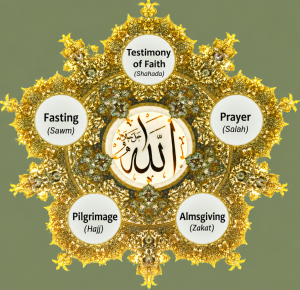
These are the five obligatory acts that structure the life of a Muslim:
The declaration of faith (Shahada): “I bear witness that there is no god but God, and I bear witness that Muhammad is His messenger.” This simple statement is sufficient to enter Islam.
Prayer (Salat): Five prayers a day, at specific times (dawn, noon, afternoon, sunset, and night). They turn the heart towards God and include recitation of the Quran, bowing, and prostration.
Zakat (alms): An obligatory annual donation (2.5% of savings) redistributed to the poor. This purifies wealth and strengthens solidarity.
The fast of Ramadan (Sawm): For one lunar month, healthy adult Muslims abstain from eating, drinking, and marital relations from dawn until sunset. It is a month of patience, sharing, and spiritual reconnection.
The pilgrimage to Mecca (Hajj): At least once in a lifetime, if health and means permit. Millions of Muslims, from all backgrounds, gather there each year in simple clothing, a sign of equality before God.
The Pillars of Faith
In addition to actions, Muslims believe in six articles of faith:
Belief in God (Allah).
Belief in His angels (such as Gabriel).
Belief in His revealed books (including the Quran).
Belief in His prophets and messengers.
Belief in the Last Day (resurrection, judgment, paradise, and hell).
Belief in destiny (good or evil comes from God), without negating human responsibility.
Some Common Misconceptions
Islam and Violence: The vast majority of Muslims reject terrorism. The Quran teaches that killing an innocent person is tantamount to killing all of humanity. Extremist groups are rejected by the overwhelming majority of believers.
Women in Islam: Islam granted women rights to inheritance, education, and consent in marriage 1400 years ago. Practices vary according to cultures, and many
Muslim women denounce traditions contrary to their faith.
Jihad: This word means “effort” or “struggle.” The greatest jihad is the effort to improve oneself (patience, honesty, prayer). Armed defense exists, but with very strict rules.
To learn more
You are always welcome in our mosque to ask questions, attend a lecture, or simply chat over tea. Islam encourages reflection, kindness, and respect for others. We hope this page has helped you gain a clearer understanding.
Peace be with you.